
How Daily MT Picks Finds the Translation Papers Worth Reading
arXiv's computational linguistics category, cs.CL, gets somewhere between 80 and 200 new papers on a typical announcement day. A handful are about machine translation. The rest are about reasoning benchmarks, agents, medical question answering, and everything else people do with language models. I work on AI translation and game localization, so I want the handful, and I want them without reading two hundred abstracts first.
Daily MT Picks is the tool I built for that. Each weekday it reads one arXiv announcement batch, ranks every cs.CL paper by how close it is to machine translation, keeps the ones that clear a bar, adds a one-line takeaway to each, and emails the result. The issues also live on this site, in the MT digest section.
It didn't start like this. The interesting part is how it got here, so this post follows the versions in order. The code is public on GitHub.
Version 0: a keyword filter
The first version was a simple parser. It looked through new papers for certain keywords and sent me the matches. It was cheap and predictable, and it had the classic keyword problem: "translation" turns up in papers about everything, while a genuinely useful paper on, say, quality estimation might never use the exact word I was looking for.
Version 1: ask the model to choose
When I set the project up properly in May 2025, the obvious upgrade was to let a language model choose. The script pulled the day's cs.CL papers, numbered them, and sent all the titles and abstracts to GPT-4o-mini with one instruction: pick up to five papers most closely related to machine translation, prefer practical work, and reply with the item numbers as a JSON array.
A second call to GPT-4o wrote a short introduction, and the result went to Buttondown, the newsletter service. This worked, but it had two problems:
- Cost grew with the day. Every run sent every abstract to the model, so a busy day cost more than a quiet one.
- It wasn't repeatable. The same day could give different picks on different runs, and I had no score to show why a paper made the cut.
The paper that changed the design
In its first week, the digest surfaced a paper from the University of Illinois and Korea University: Scientific Paper Retrieval with LLM-Guided Semantic-Based Ranking, which calls its method SemRank. The tool for finding papers had found a paper about finding papers.
SemRank's argument is that ordinary search misses the fine-grained concepts that scientific papers are really about. Its fix, roughly:
- Index each paper as a set of concepts: research topics from a trained classifier, plus key phrases an LLM picks out.
- At query time, have an LLM choose the core concepts of the query, using one short call.
- Score each paper by how close its concepts are to the query's concepts in embedding space, and blend that with a regular retriever's score.
The paper reports better recall than the usual query-expansion tricks, at a fraction of their cost: one small LLM call per query instead of generating whole hypothetical documents.
My problem was simpler than SemRank's. I don't have new queries arriving all day. I have one fixed question ("is this about machine translation?") asked of about a hundred new papers. So I took the core idea, compare papers to a set of concepts in embedding space instead of asking an LLM to judge them, and dropped everything my case didn't need. I called it SemRank-lite. It went live on 31 May 2025.
Version 2: SemRank-lite
The ranking part has no LLM at all:
- I wrote the concepts myself, as a list of what "machine translation" means to someone who works in it: machine translation, neural machine translation, document-level translation, translation evaluation (BLEU, COMET, chrF), post-editing, MTPE, MT quality estimation, linguistic quality assurance, interpreting, and a few more.
- The list is joined into one string and turned into a single concept vector with e5-large-v2, an open embedding model that runs locally on the GitHub Actions runner. It's also one of the retrievers the SemRank paper tested.
- Each paper's title and abstract become a vector with the same model, and its score is the cosine similarity to the concept vector.
- The top five go into the issue.
The language model was left with only the writing: the introduction paragraph. Ranking became free, deterministic and explainable. Every paper has a number, and I can see where the line fell.
That version ran, with small tweaks to the concept list, for well over a year. The first issue went out on 3 June 2025, and there have been about 400 since.
Version 3: the 2026 rework
In September 2026 I looked hard at what the digest was actually sending, with Claude Code doing much of the digging and the fixes. Almost every change came from measuring something.
Batches, not calendar days
The script asked arXiv for papers submitted on a given date. arXiv doesn't publish that way. It announces five batches a week, each closing at 14:00 US Eastern time. An earlier fix had made weekend dates roll back to Friday, on the theory that nothing happens at weekends. But people submit at weekends: around 40 to 55 cs.CL papers each Saturday and Sunday. Those dates were never fetched at all. That was roughly 100 papers a week, about 19% of the category, silently skipped.
Now each issue is one announcement batch. The batches tile the week with no gaps and no overlaps, through daylight-saving changes too. Monday's batch, which carries Friday afternoon, the weekend and Monday morning, is usually the biggest, with 150–200 papers.
Scores that mean something
Two fixes made the scores more useful:
- Prefixes. e5 expects a
query:orpassage:prefix on its inputs, and the script had been calling it without them. Adding them kept the same picks on strong days but widened the gap between real MT papers and filler. - z-scores. e5's raw cosine scores sit in a narrow band, roughly 0.72 to 0.83, whatever the day holds. So every paper's score is now also expressed as a z-score: how many standard deviations above its own batch's average it sits.
Here is the batch from 19 November 2026, 84 papers:
| z | Cosine | Paper | Picked |
|---|---|---|---|
| 2.92 | 0.807 | Diffusion language models for machine translation | yes |
| 2.57 | 0.802 | Represented but misread: how post-training changes what models read out | yes |
| 1.86 | 0.791 | Financial question-answering agents | no |
| 1.81 | 0.790 | Varied explanations for language models | no |
The raw scores of the second and third papers differ by 0.011. The z-scores show the actual drop.
I also tried something closer to SemRank's own scoring: matching each paper against every concept separately and taking the best match. It was worse. Short, general concepts like "translation" match almost any cs.CL abstract, so a quality-estimation paper fell from first place to fifth. There's now a comment in the code telling future me not to bring it back.
A floor, and a floor under the floor
The old ranking always returned exactly five papers, however weak the day. One August issue went out with five papers, none of them about translation, under an introduction claiming they would "shape machine translation systems".
Now a paper needs a z-score of at least 2.0 to get in. On a thin day that would leave the issue empty, so the top two papers always go in. When they fall below the floor, the introduction is told so and has to say it plainly. Over fourteen test batches, this averaged 2.8 papers an issue, never sent an empty one, and padded below the floor only twice.
2.0 is a compromise, not a clean line. Raising it to 2.2 would have rejected that bad August day completely, but it would also have dropped a genuine English–Syriac MT paper. Missing a real paper seemed worse than admitting a marginal one.
Issues worth reading
The emails had been a wall of raw abstracts. Now:
- Each paper gets a one-sentence takeaway for practitioners: the method, the number or the limitation that matters, in plain English.
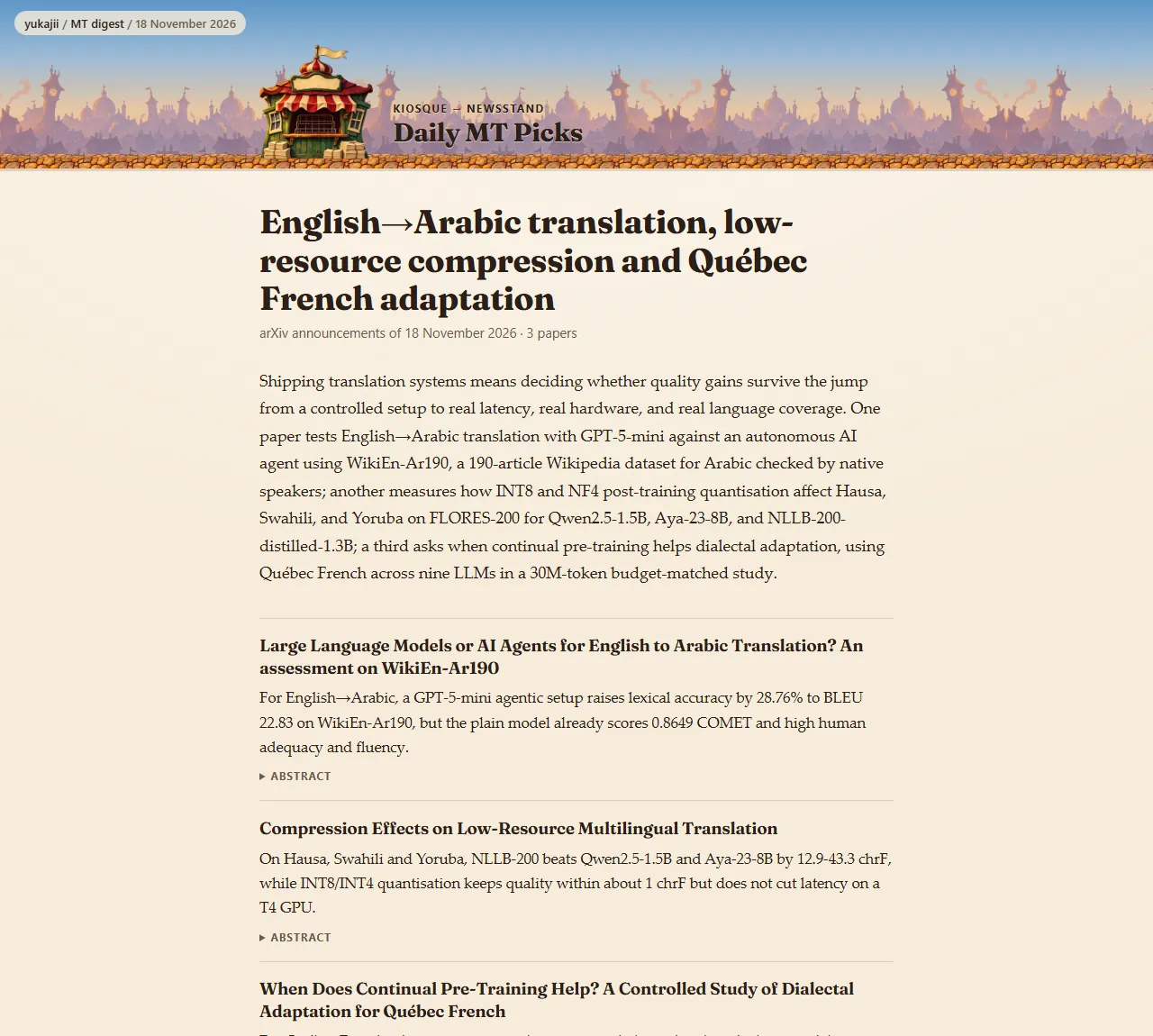
- Each issue gets a web headline naming what's in it, such as "English→Arabic translation, low-resource compression and Québec French adaptation", instead of "Machine Translation Digest for Nov 18 2026".
- The introduction rotates its opening angle. Before, issue after issue opened with some version of "Today's MT digest highlights".
- LaTeX in abstracts (
${<}100$,\textbf{...}) is cleaned into prose, because it showed up literally in the email.
The whole issue now takes three small calls to gpt-5.4-mini, for the introduction, the takeaways and the headline. The 19 November issue used about 2,200 tokens, or a quarter of a US cent.
Keeping it running
A daily job that emails people has to keep working when you aren't looking. Most of the 2026 commits are about that:
- arXiv rate limits. arXiv sometimes blocks GitHub's shared runners with HTTP 429 errors for hours. Retries with backoff weren't enough, so the job now runs three times a day, and the later runs only do anything if the earlier one failed.
- A double send. The first version of that check asked Buttondown whether the issue had already gone out. Buttondown's search didn't find it, and one issue went out twice. Now the marker is something the job controls: a GitHub artifact uploaded only after a successful send.
- A mid-week silence. The date logic made every Wednesday and Thursday run pick a batch that had already been sent, so the newsletter quietly skipped those days. The job now sends the oldest batch that hasn't gone out yet, one day after arXiv announces it, so a failed day is simply picked up the next day.
- A token that expired quietly. Issues reach this site by being committed to its repository. The access token expired in October, the emails kept going out, and the site stopped updating for two weeks before anyone noticed. Publishing now uses a deploy key that doesn't expire, and a failed publish opens a GitHub issue.
On the site
Every issue is also a page here, but only the ones with takeaways, 47 so far. The older issues are just a title and abstracts copied from arXiv, and a page of copied abstracts gives a reader nothing they can't get from arXiv itself. Their papers aren't lost: all 1,865 are listed in a searchable paper index, with links to the original abstracts.
What I'd tell someone building one
- Use the LLM to write, not to rank. Embeddings plus a hand-written concept list beat an LLM picker on cost and repeatability, and a score you can log is a score you can debug.
- Read the papers in your own pile. The best design idea in this project came from a paper the digest itself delivered.
- Measure the scores before setting thresholds. Raw similarity scores looked meaningful and weren't. Relative scores within each batch were.
- Check the pipeline against the source's real schedule. "Nothing happens at weekends" sounded true and cost a fifth of the papers.
- Make every failure loud. Every silent failure in this project, the skipped weekends, the quiet mid-week, the dead token, lasted longer than any noisy one.
If you work with machine translation, you can get the digest by email, or just browse the archive.